Give GitHub Actions its own Battleship.
Run your team's jobs on a whole machine for one monthly price. When the machine fills up, the next job waits. The bill stays put.
New sign-ups open soon. Already have an account? Sign in.

a month for 8 cores · 16 threads · 64 GB, however busy it gets
until dependencies are ready on a warm run of our monorepo, 17 Nov 2026
for a free machine to pick up a job
extra when jobs queue. A longer queue never changes the bill
One line change to get started.
Change it yourself
runs-on: battleship-ubuntu-latestKeep every step you already have. The quickstart has the rest.
Or hand it to your agent
- Claude Code
- Codex
- Cursor
- OpenCode
The prompt asks for the same one line change in your Linux jobs, and for the diff before anything is committed.
How busy is your CI?
Other runners charge by the minute. Battleship is one flat price. Drag the slider to the hours your CI runs each month and see which costs less.
Hover or tap a price to see how it is worked out.
How these are worked out
- GitHub-hosted · 16 vCPU · $0.042 per minute · 175 h × 60 × $0.042 = $441 · list price read 17 Nov 2026 (pricing page)
- Blacksmith · 16 vCPU · $0.032 per minute · 175 h × 60 × $0.032 = $336 · list price read 17 Nov 2026 (pricing page)
- Jog Max · 16 vCPU · $0.0176 per minute · billed by the second · 175 h × 60 × $0.0176 = $185 · list price read 17 Nov 2026 (pricing page)
- Jog standard · 16 vCPU · $0.0088 per minute · billed by the second · 175 h × 60 × $0.0088 = $92 · list price read 17 Nov 2026 (pricing page)
- 8 cores · 16 threads · 64 GB · $144 a month, flat (pricing)
The next run starts with the cache on disk.
We ran the same commit of our 3,677-package monorepo twice. On the second run our machine read its dependencies from its own disk. The Jog runners downloaded their caches first.
Real time. The clock stops when the first runner has its dependencies ready. 17 Nov 2026, warm-run medians, 5 runs on our machine and 3 on each Jog tier, all at 16 vCPU and 64 GB. Whole job through typecheck: 46 s on ours, 85 s on Jog Max, 137 s on Jog standard.
On 18 Nov 2026, with the full test suite included, Jog Max took 538 s, our machine 567 s and Jog standard 830 s. One warm run each. The local cache wins the set-up. Jog Max ran the tests themselves faster.
A budget limit stops your business. A queue does not.
On a meter, the only way to cap the bill is a spending limit. When it is reached, jobs stop until a person notices, finds the setting and raises it. A Battleship has nothing to cap. When the machine is full the next job waits its turn, a free machine picks it up in 2 to 3 seconds, and the price does not move.
$46.37 today × 22 working days = about $1,020 a month. This assumes every working day is like this one. A quieter day costs less on a meter.$46.37 today
Jobs run: 113 of 138 on time, 25 delayed
spentbudgetbudget reached: nothing starts
- 11:22 budget reached 11:47 raised to $30 15:24 budget reached 15:49 raised to $45 17:48 budget reached 18:13 raised to $60
- First budget $15. Final budget $60.
- 25 jobs delayed. Assumption: each time the budget is reached, it takes 25 minutes for someone to notice, find the setting and raise it.
$144 ÷ 22 working days = $6.55 a working day. The price is the same however many jobs run.$6.55 per working day
Jobs run: 138 of 138
runningwaiting for a free slotmachine full: 4 jobs at once
- Every job ran
- One Frigate runs 4 jobs at once. When all 4 slots are busy, the next job waits for one to free up. Waiting adds nothing to the bill.
- Same bill tomorrow
The same day, every working day: about $1,020 a month on a meter, $144 on Battleship.
Hover or tap an underlined figure to see what is behind it.
What is behind these figures
- $46.37 today × 22 working days = about $1,020 a month. This assumes every working day is like this one. A quieter day costs less on a meter.
- $144 ÷ 22 working days = $6.55 a working day. The price is the same however many jobs run.
- Budget raised 3 times: 11:22 budget reached; 11:47 raised to $30; 15:24 budget reached; 15:49 raised to $45; 17:48 budget reached; 18:13 raised to $60.
- $45 over the first budget: First budget $15. Final budget $60.
- Stopped for 1 h 15 min: 25 jobs delayed. Assumption: each time the budget is reached, it takes 25 minutes for someone to notice, find the setting and raise it.
- 72 waited their turn: One Frigate runs 4 jobs at once. When all 4 slots are busy, the next job waits for one to free up. Waiting adds nothing to the bill.
An example day, not a measurement: 46 pushes between 08:00 and 18:00, each starting 3 jobs of 8 minutes: 138 jobs. Pushes an hour: 2 at 08:00, 4 at 09:00, 6 at 10:00, 6 at 11:00, 2 at 12:00, 3 at 13:00, 5 at 14:00, 7 at 15:00, 8 at 16:00, 3 at 17:00, at fixed minutes inside each hour. Metered spend = job minutes × $0.042 a minute: 138 jobs × 8 min × $0.042 = $46.37 for the day. The metered runner starts every job at once, and starts a job only while the budget covers its full 8 minutes. The $15 daily budget and the $15 added each time are examples. The rate is the GitHub-hosted 16 vCPU list price read 17 Nov 2026. Assumption: each time the budget is reached, it takes 25 minutes for someone to notice, find the setting and raise it. One Frigate runs 4 of these jobs at a time, first come, first served. The metered price is for a 16 vCPU runner per job; on the Frigate the 4 jobs share its 16 threads, and we assume a job still takes 8 minutes. A free machine takes 2.5 seconds to pick a job up. Monthly figures assume 22 working days a month, each like this one: $46.37 × 22 = about $1,020 on a meter, and $144 ÷ 22 = $6.55 a working day on Battleship. Real days differ: a quieter day costs less on a meter, so its month can come in lower. The Battleship price is $144 either way. Arrival times are fixed, so the day plays the same every time.
On metered runners that enforce a spending limit, jobs stop when it is reached. GitHub's billing documentation says that when a budget with "Stop usage when budget limit is reached" is exhausted, additional usage is blocked until the next billing cycle or until the budget is increased. Setting up budgets, read 18 Nov 2026.
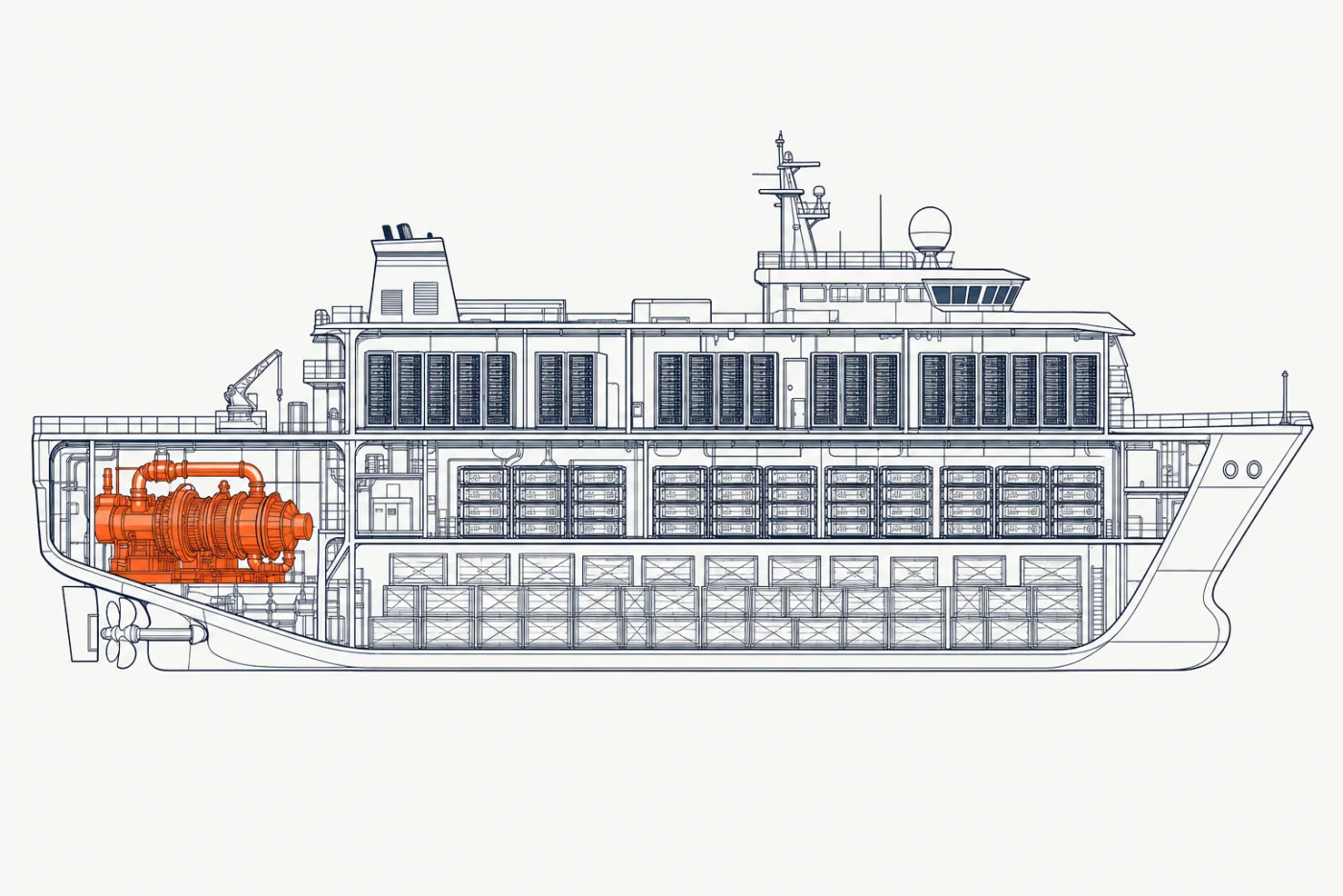
Every ounce of metal is yours.
- Dedicated hardware. Only your organisation runs jobs on the machine. Its idle time is yours too.
- A cache in the hold. Your dependencies stay on the ship's own disk between runs. On our monorepo the next run had them ready in 5.3 seconds, against 46 seconds on Jog Max (17 Nov 2026).
- A place in the queue. When all your machines are busy, the next job waits at no extra charge.
- A predictable bill. More runs on the same machine leave its monthly price unchanged. What a ship caches on its own disk is never charged.
- Your place. Choose France, Germany, Canada or US East.
We are paid for the machine, not the minute.
A meter earns more when your job runs long. We earn the same either way, so every second we cut from a job is yours.
Equip your agents for battle.
Pick the ship that fits the work. Bigger ships carry more cores and more memory.






Every ship is a whole machine at one monthly price. On-ship cache is free. Shared cache between ships: 10 GB free, then $0.03 per GB you use. Example stock, not live. Pick your place: France, Germany, Canada or US East. Example ships are ready in hours, some in 1 to 3 days. The Carrier's price is proposed, not final.
Choose a shipThree steps, one small change.
- Choose a ship.Pick the cores and memory your team needs.
- Install the GitHub App.Then change
runs-ontobattleship-ubuntu-latestin the job you want to move. See the change. - Run your workflow.Jobs go to your machine. When your machines are full, the next job waits for room.
Fair questions.
What changes in our workflow?
Install the Battleship GitHub App, then change one line: runs-on: battleship-ubuntu-latest. Keep the job steps you already use. See the change.
What happens when every machine is busy?
The next job waits until a machine has room. A longer queue adds no charge.
Are 16 threads the same as 16 cores?
No. The Frigate's Ryzen 7 9700X has 8 cores and 16 threads. Metered runners would call that 16 vCPU, so that is what we compare it with.
Is a flat price worth it if we run CI now and then?
Probably not. A metered runner costs less at low use. Try the slider with your real hours, quiet ones included.
Will our whole test suite finish sooner?
That depends on where the job spends its time. The local cache helps set-up. In our 18 Nov 2026 run with tests, Jog Max finished in 538 s and our machine in 567 s.
What is on the bill besides the ship?
Usually nothing. Queued jobs cost nothing. What a ship keeps on its own disk is never counted. With two or more ships, they share a cache of dependencies (for example pnpm packages), build outputs and the workspace history they have in common. 10 GB of it is always free. Above that you pay $0.03 per GB a month for what you actually store, averaged over the month: with a 100 GB limit and 30 GB stored, that is 20 × $0.03 = $0.60. The limit is a cap you set in organisation settings (10 GB by default); at the limit, the least recently used entries are dropped. With one ship there is no shared cache and nothing to pay. If you go back down to one ship, the shared cache is queued for deletion straight away. Your code is never deleted.
Can we start today?
Not yet. New sign-ups open soon. If you already have an account, sign in as usual.
Want private hosting or annual discounts?
Talk to us about a private fleet, annual terms or anything this page does not cover.
Pick the ship for your next build.
Choose the cores and memory your jobs need. See the monthly price before you order.